
Richard Montgomery 'bomb ship' masts to go
Work to remove the masts from the wreck of Sheppey’s 'bomb ship' the SS Richard Montgomery is to begin this September.
The Department for Transport (DfT) has confirmed the £9.5 million operation, delayed from 2022, will now finally go ahead.

An underwater platform from a floating rig will be provided for specialist maritime engineers using diamond cutters to remove the three masts of the Second World War USA Liberty ship.
A Montycam, set up on top of the Isle of Sheppey Sailing Club in Marine Parade, Sheerness, is now trained on the wreck and broadcasting live footage so Islanders and visitors can keep track of the progress.
Watch Montcam here: https://tinyurl.com/MontyWreckCam
The vessel sank in August 1944 after drifting onto a sandbank during a storm.
At the time, it was packed with 6,127 tons of explosives including white phosphorous and cluster bombs, some of which remain in its hold and scattered over the seabed.

Once removed, the masts will be taken to Chatham Historic Dockyard for preservation although campaigners, including Sittingbourne and Sheppey MP Kevin McKenna, are hoping their final resting place will be on display on the Island.
Aviation, maritime and decarbonisation minister Keir Mather, talking to the BBC, said it was important for “local people” to reflect on the contribution the ship made to the UK's war effort and showed the strength of the “special relationship” between the UK and USA.
Paul Barnard, deputy chief executive of Chatham Historic Dockyard, said the masts had become "a familiar landmark for generations of people" and were also "an internationally important reminder of the Allied war effort".

The shipwreck is surrounded by an exclusion zone although it is still proving to be a popular tourist attraction with boat trips offered by Medway's Jetstream Tours and the Queenborough-based X-Pilot: Kent's Classic Pilot Vessel.
Specialist contractors Resolve Marine will carry out the delicate work after liaising with emergency services, harbour authorities and other organisations.
Project manager Nolan Conway said the project would be "a significant milestone" at one of the UK's most closely monitored wrecks.
Robin Rickard, managing director of Exord Ltd, which provided explosives advice to the DfT, said the masts would be removed with "minimal contact with the wreck".
He said there had been "wild speculation about catastrophic events and what that might look like" 20 or 30 years ago but added: "We've come a long way since then."
The masts are being removed because they are rusting and in danger of collapsing onto the rest of the ship and the explosives still stored beneath.

The masts should have been taken down four years ago (June 2022) for half the price but it is understood the original contractors baulked when they realised how much unexploded ordinance was still on the seabed.
The government has since paid to have the area surveyed.
The new contract will run for a year, with a possible 12-month extension depending on the weather.
Resolve Marine, the parent company of the salvage operator, is based in Fort Lauderdale, Florida. It was involved in the rescue work following the Deepwater Horizon rig explosion in the Gulf of Mexico in 2010.
The SS Richard Montgomery, an American Liberty ship built in 1943, had been bound for Cherbourg with munitions to support the Normandy invasion.
However, while sheltering at The Nore anchorage off Sheerness, she was dragged onto a sandbank during a storm on the night of August 20, 1944. As the tide turned, she broke her back and her hull cracked open.
The wreck is 1.5 miles from Sheerness and five miles from Southend and can still be clearly seen from the shore.

A Rochester-based stevedore company was given the first job of trying to remove the deadly cargo and began work on August 23, 1944.
The sensitive unloading continued, in difficult conditions, until September 25 when the ship was abandoned before all the cargo could be recovered after a demand for 'danger money' from the salvage team was refused.
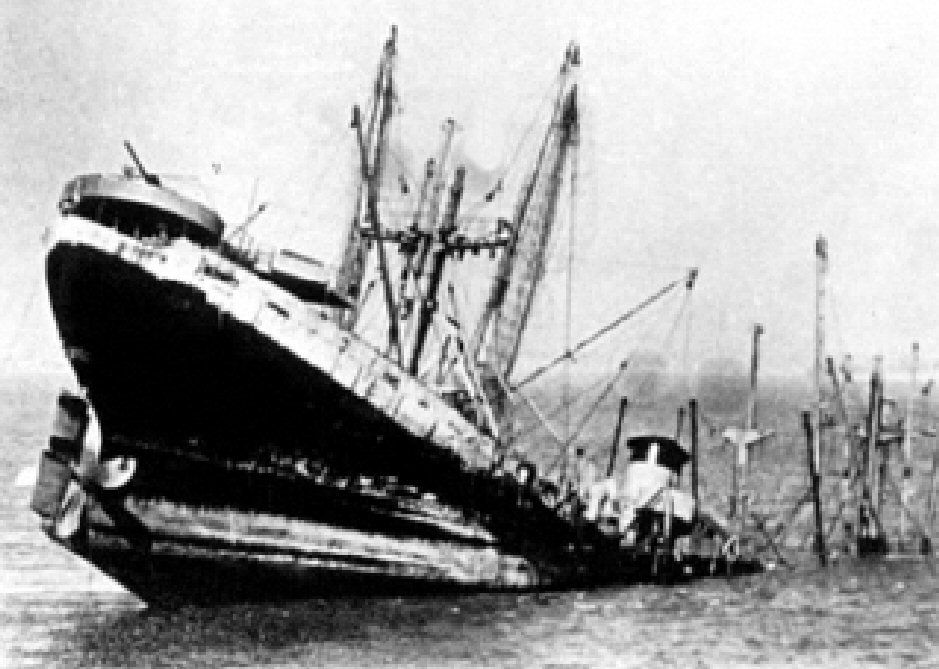
During the inquiry into the shipwreck it was revealed that several vessels moored nearby had noticed the Richard Montgomery drifting towards the sandbank and had attempted to warn the crew by sounding their sirens.
But the Montgomery failed to respond.
Some reports suggest that its captain had already gone ashore to study nautical charts fearing that the anchorage he had been given was not deep enough.
A board of inquiry later concluded that the anchorage assigned by the harbour master Lt Cmd Walmsey, who was based on Southend Pier (renamed HMS Leigh), had put the ship in jeopardy and its skipper Captain Wilkie was returned to duty.

Latest surveys say the masts, home to a colony of cormorants, are now so weak with rust that they could break off and fall onto the rest of the ship, which is still packed with 1,400 tonnes of explosives.
The Port of London vessel Maplin was in the area in April carrying out a new survey with sonar equipment. All other ships have been told to proceed with caution.

News of the latest recovery attempt has rekindled fears that the distinctive masts might be lost forever. There is a battle raging between Sheppey and Southend to see who can secure the masts and put them on show.
Labour MP for Sittingbourne and Sheppey Kevin McKenna has launched a petition calling on the government to 'gift' one of the Monty Masts to the people of Sheppey.

He said: "For many, the Montgomery masts are far more than wreckage; they're a cherished landmark linked to an extraordinary wartime story.”
He added: “I fully support their safe removal and believe it's vital that part of this iconic structure is preserved for future generations.”
Shortly after, a formal letter from the US Ambassador Warren A Stephens on behalf of the US Department of Transportation confirmed the transfer of the masts to the UK government following their “safe removal” from the wreck.

Previously, Islander Chris Foulds had come up with an idea to 'plant' the masts in the moat at Sheerness and created a visual showing how they could look.
One of the reasons given for not removing the Montgomery explosives is said to be because of what happened to the Polish cargo ship Kielce which sank off Folkestone in July 1967 and was also carrying munitions.
During preliminary work to lift it, the ship exploded with a force equivalent to an earthquate registering 4.5 on the Richter scale, leaving a 20-feet-deep (6m) crater in the seabed.
It was carrying "just a fraction" of the explosives on board the Montgomery and was in deeper water and at least three miles from the Kent coast.
According to a BBC news report in 1970, an explosion on the Montgomery could throw a 980-feet-wide (300m) column of water and debris nearly 9,800 feet (3,000m) into the air and generate a tidal wave 16 feet (5m) high causing a 'Thames tsunami'.
It predicted that almost every window in Sheerness would be blown out and buldings damaged by the blast. The Isle of Grain, which boasts the largest LNG terminal in Europe, would also be in the firing line.
Last year National Grid sold the terminal to British Gas-owner Centrica for £1.7 billion.

The dramatic story of the Richard Montgomery has also been told in a striking documentary called An Accident Waiting To Happen made by Sittingbourne film-maker Ken Rowles, a former Swale councillor. It is yet to be broadcast but has been viewed in private screenings in Sittingbourne and on Sheppey.
Interestingly, there is a document on show at the Blue Town Heritage Centre revealing that the Americans had previously claimed to have paid to have had the wreck salvaged.

According to reports they had offered to remove it in 1948 and 1967 but both times the British government apparently refused.
The Richard Montgomery, affectionately known as Monty by Islanders, was ironically named after an Irish-born American army officer (1738-1775) who fought in the American War of Indpendence against the British.

The SS Richard Montgomery was built to an all-welded design in Florida and launched in July 1943. It cost $2.1million, weighed 10,000 tons and was 441-feet long, 57-feet wide and 82-feet tall. It carried a crew of 46 plus 35 gunners. No lives were lost in its sinking.

A Department for Transport spokesman said: "The condition of the wreck remains stable and experts are continuing to monitor the site."
A flying restriction order remains in place above the area with pilots and drone operators warned to stay away.
To sign MP Kevin McKenna's petition, click on https://actionnetwork.org/.../save-the-mongomery-masts.../


Comments